The 4.7.11 rock paper scissors CodeHS assignment is a popular beginner programming challenge designed to help students master conditionals, user input, random number generation, and logical comparison in Java. At first glance, it seems simple because the game itself is familiar. However, this task is carefully structured to reinforce foundational programming concepts that every new coder must understand before moving into more advanced topics.
In this in-depth guide, you’ll learn exactly how the 4.7.11 rock paper scissors CodeHS exercise works, what concepts it tests, how to structure your solution, and how to avoid common mistakes. By the end, you’ll not only understand how to complete the assignment successfully but also gain a stronger grasp of conditional logic and Java fundamentals.
What Is CodeHS and Why 4.7.11 Matters
CodeHS is an interactive online learning platform used in schools worldwide to teach computer science. It offers structured lessons, coding exercises, quizzes, and projects in multiple programming languages, including Java and Python.
The 4.7.11 rock paper scissors CodeHS assignment typically appears in a Java unit focused on conditionals and control flow. By this stage, students have already learned how to declare variables, use Scanner for input, and write basic if-else statements. This assignment tests their ability to combine these concepts into a working program.
The importance of 4.7.11 rock paper scissors CodeHS lies in how it reinforces logical reasoning. Students must compare two inputs and determine the correct outcome based on defined rules. That logical comparison is central to nearly all programming tasks.
Also Read:Pink and Marble The Ultimate Guide to Timeless, Elegant Design
Understanding the Rock Paper Scissors Logic
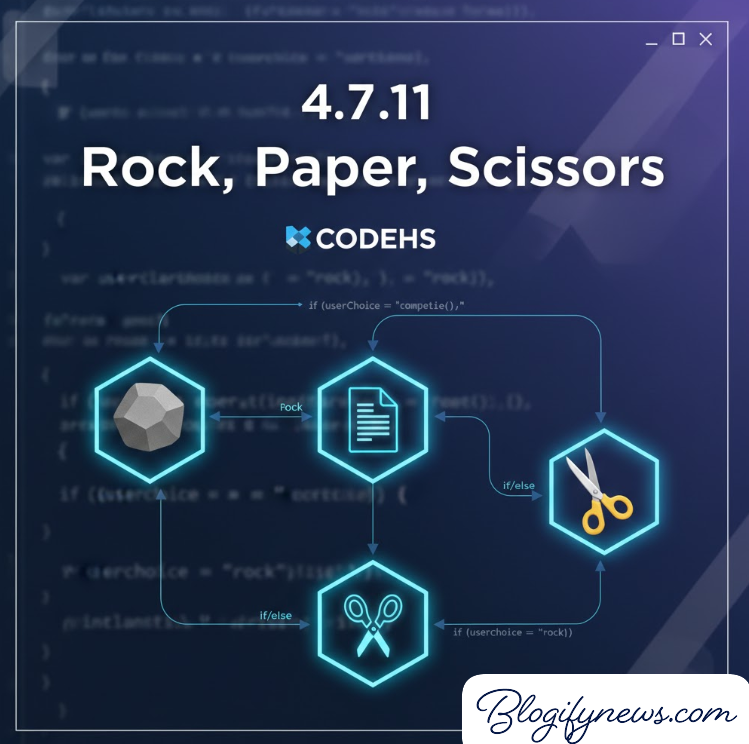
Before writing code, you must understand the rules clearly. Rock beats scissors. Scissors beats paper. Paper beats rock. If both players choose the same option, the result is a tie.
In the context of 4.7.11 rock paper scissors CodeHS, the program typically involves a user playing against the computer. The user enters a choice, and the computer randomly selects one.
The program must then compare both choices and print the correct result.
This exercise teaches students how to convert real-world rules into structured programming logic. That translation from human reasoning into code is a critical programming skill.
Core Concepts Tested in 4.7.11 Rock Paper Scissors CodeHS
Conditional Statements
Conditional statements form the backbone of this assignment. Students must use if, else if, and else statements to determine the winner.
For example, if the user chooses rock and the computer chooses scissors, the program must recognize that rock wins. Each possible combination must be handled properly.
Random Number Generation
The computer’s move is usually generated randomly. In Java, this is often done using the Random class.
The program might assign numbers to represent rock, paper, and scissors. For instance, zero might represent rock, one paper, and two scissors.
User Input Handling
Students must collect user input using Scanner. Handling input correctly ensures the program behaves as expected. This often includes converting input to lowercase to avoid case-sensitivity issues.
String Comparison
Many beginners mistakenly use double equals to compare strings in Java. The correct method is equals or equalsIgnoreCase. The 4.7.11 rock paper scissors CodeHS assignment often reveals this common error.
Step-by-Step Structure of the Program
When solving 4.7.11 rock paper scissors CodeHS, it helps to follow a clear structure.
First, import necessary libraries. Then create the main class and method. Next, gather user input. After that, generate the computer’s random choice. Finally, use conditional logic to determine and print the winner.
Below is a simplified example of how the structure might look in Java:
import java.util.Scanner;
import java.util.Random;public class RockPaperScissors {
    public static void main(String[] args) {
        Scanner input = new Scanner(System.in);
        Random rand = new Random();        System.out.println("Enter rock, paper, or scissors:");
        String userChoice = input.nextLine().toLowerCase();        int computerNumber = rand.nextInt(3);
        String computerChoice = "";        if (computerNumber == 0) {
            computerChoice = "rock";
        } else if (computerNumber == 1) {
            computerChoice = "paper";
        } else {
            computerChoice = "scissors";
        }        System.out.println("Computer chose: " + computerChoice);        if (userChoice.equals(computerChoice)) {
            System.out.println("It's a tie!");
        } else if (userChoice.equals("rock") && computerChoice.equals("scissors")) {
            System.out.println("You win!");
        } else if (userChoice.equals("paper") && computerChoice.equals("rock")) {
            System.out.println("You win!");
        } else if (userChoice.equals("scissors") && computerChoice.equals("paper")) {
            System.out.println("You win!");
        } else {
            System.out.println("Computer wins!");
        }
    }
}
This demonstrates the logic flow required for 4.7.11 rock paper scissors CodeHS. Your specific instructions may vary slightly, but the core structure remains consistent.
Also Read:M Power FastTrack MK2 vs G Sharp Edge Chisel Sharpener The Ultimate Comparison Guide
Common Mistakes Students Make
Understanding common errors can help you avoid them.
One frequent mistake in 4.7.11 rock paper scissors CodeHS is using == instead of equals when comparing strings. In Java, == checks memory reference, not content. This results in incorrect comparisons.
Another mistake is failing to normalize user input. If a user types Rock instead of rock, the comparison may fail unless equalsIgnoreCase or toLowerCase is used.
Some students also forget to handle ties first. Checking for equality early simplifies logic and reduces redundant conditions.
Others misuse random number bounds. Using nextInt(3) ensures values from zero to two, which aligns with three possible choices.
Why This Assignment Is Pedagogically Important
The 4.7.11 rock paper scissors CodeHS assignment builds algorithmic thinking. According to educational research in computer science pedagogy, beginner programmers often struggle with logical branching and nested conditionals.
Games like rock paper scissors simplify the learning environment. The rules are already known, so students can focus entirely on translating logic into code.
Studies in programming education show that early exposure to conditionals improves problem-solving accuracy in later topics such as loops, arrays, and object-oriented design.
This assignment also introduces randomness, which is foundational in simulations, games, and statistical programs.
Enhancing Your 4.7.11 Rock Paper Scissors CodeHS Solution
Although the assignment may require only a single round, you can expand it for practice.
You could add a loop to allow multiple rounds. You could track scores. You could validate user input and re-prompt for incorrect entries.
For example, adding a while loop allows the game to continue until the user decides to stop.
Improving input validation also strengthens your program’s reliability. Instead of assuming correct input, check whether the input matches rock, paper, or scissors before proceeding.
These enhancements demonstrate deeper understanding and align with best coding practices.
Best Practices for Writing Clean Java Code
Even in beginner assignments like 4.7.11 rock paper scissors CodeHS, clean code matters.
Use meaningful variable names. Avoid deeply nested conditionals. Keep indentation consistent. Add comments explaining major logic sections.
Readable code is easier to debug and maintain. Professional developers prioritize clarity as much as functionality.
Additionally, test your program multiple times. Run scenarios where the user wins, loses, and ties. Testing ensures logical completeness.
Also Read:Tiger Paws Power, Precision, and Symbolism in Nature and Culture
Debugging Strategies for 4.7.11 Rock Paper Scissors CodeHS
When your program doesn’t work as expected, debugging systematically helps.
Print out both user and computer choices before evaluating the winner. Confirm that string comparisons are functioning correctly.
Check for typographical errors in strings. Even a small mismatch like “scissor” instead of “scissors” can break logic.
Use temporary print statements to trace program flow. Once the program works, you can remove or comment them out.
Learning to debug effectively is as important as writing code.
Real-World Applications of This Logic
The logic used in 4.7.11 rock paper scissors CodeHS extends beyond simple games.
Conditional branching powers decision-making systems in real applications. E-commerce websites determine shipping options based on location. Banking apps verify transactions based on rules. Video games rely heavily on conditional outcomes.
Even artificial intelligence models use decision structures internally, though at a more complex scale.
Understanding conditional comparisons at this stage builds a foundation for advanced programming concepts.
SEO Perspective on Educational Coding Topics
Educational coding topics like 4.7.11 rock paper scissors CodeHS attract consistent search traffic because students frequently seek clarification.
Search intent typically includes finding solutions, understanding logic, or troubleshooting errors. Writing comprehensive guides that explain reasoning instead of just copying answers aligns with best practices and academic integrity.
Helpful content should guide learning, not encourage shortcut copying. That’s why explanation matters more than simply providing final code.
Conclusion
The 4.7.11 rock paper scissors CodeHS assignment may appear simple, but it plays a critical role in developing core programming skills. By combining conditional logic, random number generation, user input handling, and string comparison, this exercise reinforces essential Java fundamentals.
Approach the task methodically. Understand the game rules. Translate those rules into structured logic. Test thoroughly. Debug carefully. Write clean, readable code.
Mastering this Rock Paper Scissors exercise prepares you for more advanced programming challenges ahead. With a solid grasp of these basics, you’ll be well equipped to tackle loops, arrays, methods, and object-oriented concepts in future lessons.
By focusing on learning rather than memorizing, you transform a simple classroom assignment into a powerful step toward programming expertise.
FAQs
What does 4.7.11 Rock Paper Scissors programming task in CodeHS teach?
It teaches conditionals, random number generation, string comparison, and input handling in Java.
Why isn’t my string comparison working?
You may be using == instead of equals. Always use equals or equalsIgnoreCase when comparing strings in Java.
How do I generate a random choice?
Use the Random class and nextInt with a bound of three to represent rock, paper, and scissors.
Can I improve the assignment beyond requirements?
Yes. Adding loops, score tracking, and input validation strengthens your understanding.
For more updates visit: blogify News