Many students encounter the symbol e in algebra or calculus and immediately ask, what does e stand for in math? Unlike variables such as x or y, the letter e is not a placeholder. It represents a powerful mathematical constant that plays a central role in exponential growth, natural logarithms, compound interest, probability theory, and differential equations.
Understanding what does e stand for in math is essential for anyone studying higher mathematics, economics, engineering, physics, or statistics. This constant appears whenever quantities grow or decay continuously. From modeling population growth to calculating continuously compounded interest, e helps describe how change happens in the real world.
In this comprehensive guide, you will explore the definition of e, its historical development, its exact value, its properties in calculus, and its practical applications across disciplines. By the end, you will clearly understand why e is one of the most important numbers in mathematics.
The Definition of E in Mathematics
When asking what does e stand for in math, the precise answer is that e represents a mathematical constant approximately equal to 2.71828. It is commonly known as Euler’s number, named after the Swiss mathematician Leonhard Euler, who formalized its notation and expanded its applications in the 18th century.
Unlike ordinary numbers, e is irrational. Its decimal expansion continues infinitely without repeating. Moreover, mathematicians have proven that e is transcendental, meaning it is not the solution to any polynomial equation with rational coefficients.
Although the value 2.71828 may seem arbitrary at first glance, it arises naturally in problems involving continuous change. That natural emergence is what makes e unique.
The Exact Value and Mathematical Definition
The constant e is defined using limits from calculus. One formal definition is:
e = lim (1 + 1/n)ⁿ as n approaches infinity
This expression connects directly to compound interest. As the number of compounding periods increases without bound, the result approaches e.
For practical purposes, e is often rounded to 2.71828 or 2.7183. However, mathematicians have calculated trillions of digits of e for research and computational purposes.
Because e is irrational, its decimal form never repeats. Consequently, it cannot be written as a simple fraction.
Also Read:3840 x 1240 Naruto x Boruto Ultimate Banner The Complete Ultra-Wide Guide
The Historical Origin of E
The question of what does e stand for in math has historical roots in finance. In the late 17th century, the Swiss mathematician Jacob Bernoulli studied compound interest.
He considered a scenario in which one dollar earns 100 percent interest annually. If the interest is compounded once per year, the total becomes two dollars. If compounded more frequently, the final amount increases. As the compounding frequency becomes infinitely large, the amount approaches approximately 2.71828.
Later, Leonhard Euler adopted the letter e to represent this constant and investigated its properties in depth. Over time, the symbol became standard in mathematics worldwide.
Why E Is Called the Natural Base
Unlike base 10, which aligns with our number system, base e arises organically in calculus and growth processes.
When modeling continuous growth, exponential functions with base e simplify differentiation and integration. Because of this convenience, mathematicians refer to e as the natural base.
In other words, e does not appear because humans chose it arbitrarily. Instead, it appears because mathematics itself demands it in certain situations.
E in Exponential Functions
Exponential functions describe processes where the rate of change depends on the current amount. These functions often use e as their base.
A general exponential growth formula is:
y = Ce^(kt)
In this equation, C represents the initial value, k represents the growth rate, and t represents time.
When k is positive, the function models growth. When k is negative, it models decay.
Because many real-world processes follow this pattern, understanding what does e stand for in math becomes essential for interpreting exponential behavior.
E and Continuous Compound Interest
One of the most practical applications of e appears in finance. Continuous compounding uses the formula:
A = Pe^(rt)
Here, P represents the starting amount, r denotes the annual interest rate expressed as a decimal, and t represents the length of time.
Continuous compounding assumes interest is calculated infinitely often. Although no bank compounds interest literally every instant, this model closely approximates frequent compounding.
Also Read:Tiger Paws Power, Precision, and Symbolism in Nature and Culture
For example, if 1,000 dollars are invested at a 5 percent annual rate for five years with continuous compounding, the final amount can be calculated using e.
Financial analysts, economists, and investors rely on this formula to evaluate growth over time.
E in Calculus
Calculus gives e its greatest significance. When differentiating exponential functions, e produces a remarkable result.
The derivative of eˣ equals eˣ.
No other base behaves this way. For a general base a, the derivative of aˣ equals aˣ multiplied by ln(a). However, because ln(e) equals 1, the expression simplifies beautifully when the base is e.
Similarly, the integral of eˣ equals eˣ. These properties make e indispensable in solving differential equations.
Engineers, physicists, and data scientists frequently use these relationships when modeling rates of change.
The Natural Logarithm and E
The natural logarithm, written as ln(x), is directly connected to e.
If eˣ equals y, then ln(y) equals x.
This inverse relationship allows mathematicians to solve exponential equations efficiently. For example, if eˣ equals 7, taking the natural logarithm of both sides yields x equals ln(7).
Because of this powerful connection, logarithmic equations and exponential growth problems become easier to handle.
E in Probability and Statistics
Another area where the question what does e stand for in math becomes relevant is probability theory.
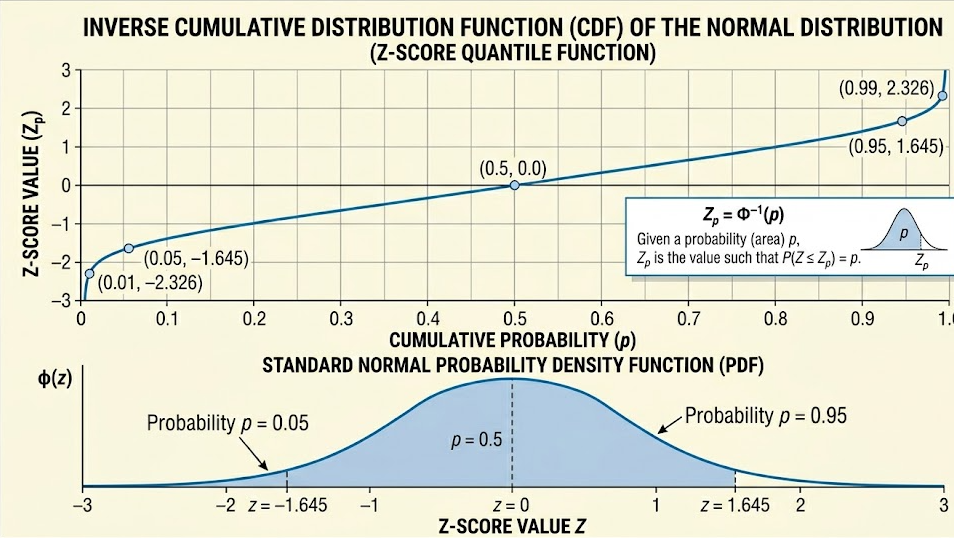
The exponential distribution, which models waiting times between events, uses e in its formula. The normal distribution, often called the bell curve, also contains e in its probability density function.
Statistical models in economics, machine learning, and data science frequently incorporate exponential expressions with base e.
As a result, understanding e is critical for interpreting real-world data.
Also Read:Classroom 30x Redefining the Future of Smart Learning Environments
E in Science and Engineering
Scientific models often describe natural processes using exponential functions.
In biology, population growth may follow an exponential pattern when resources are abundant. In physics, radioactive decay follows an exponential decay law. In chemistry, reaction rates sometimes depend on exponential relationships.
Additionally, electrical engineers use exponential functions to analyze circuits involving capacitors and inductors.
Because these processes involve continuous change, the constant e naturally appears in their mathematical descriptions.
E and Complex Numbers
One of the most elegant formulas in mathematics connects e to complex numbers:
e^(iθ) = cos(θ) + i sin(θ)
This identity links exponential functions with trigonometry.
When θ equals π, the formula becomes:
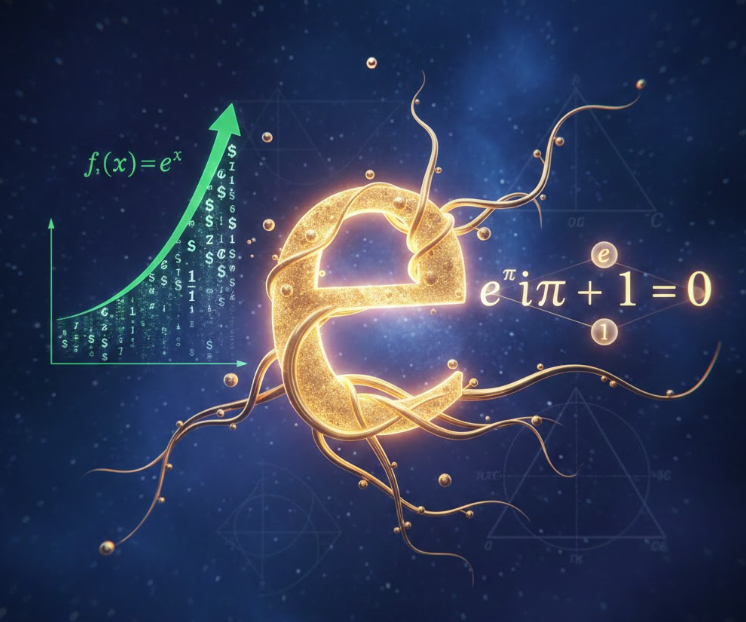
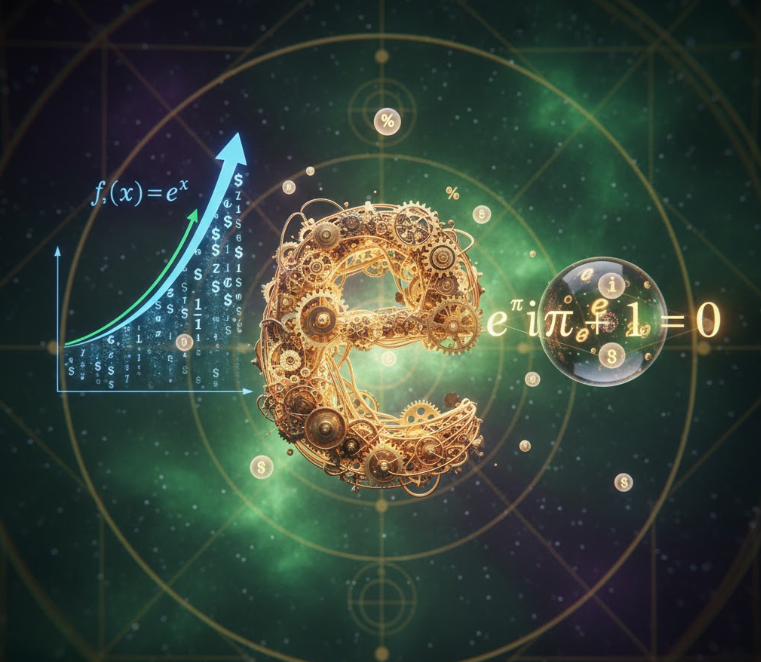
e^(iπ) + 1 = 0
This equation connects five fundamental mathematical constants: e, π, i, 1, and 0. Many mathematicians consider it one of the most beautiful relationships in mathematics.
Common Misconceptions About E
Some students assume that e stands for exponent. In reality, e is a fixed constant.
Others believe that e appears only in calculus. However, it also plays a role in algebra, statistics, finance, physics, and computer science.
Additionally, some learners confuse e with π. While both are irrational constants, π relates to circles and geometry, whereas e relates to exponential growth and continuous change.
Clarifying these misconceptions helps build a stronger conceptual foundation.
Why Understanding E Matters
Grasping what does e stand for in math strengthens overall mathematical literacy. Students who understand e can more easily work with exponential equations, logarithms, growth models, and differential equations.
Moreover, standardized exams and university-level courses frequently include problems involving e.
Beyond academics, financial planning, investment analysis, epidemiology, and data science all rely on exponential modeling.
Therefore, understanding e is not just theoretical. It has real-world value.
Conclusion
So, what does e stand for in math?
The symbol e represents Euler’s number, approximately equal to 2.71828. More importantly, it serves as the natural base of exponential functions and logarithms. Its unique properties in calculus make it essential for differentiation and integration, while its appearance in finance, science, and probability highlights its practical importance.
Whenever change occurs continuously, e is likely involved. From compound interest and population growth to statistical modeling and differential equations, this constant provides a powerful framework for understanding the world.
By mastering what does e stand for in math, you gain insight into one of the most fundamental ideas in modern mathematics.
Frequently Asked Questions
What does e stand for in math?
It represents Euler’s number, a mathematical constant approximately equal to 2.71828 that serves as the base of natural logarithms.
Why is e important?
E simplifies calculus operations and models continuous growth and decay in real-world systems.
Is e irrational?
Yes. Its decimal expansion continues forever without repeating.
Where is e used in everyday life?
E appears in compound interest calculations, population growth models, probability distributions, and scientific equations.
For more updates visit: blogify News