Mastering the alternative fingering g sharp baritone sax technique can dramatically improve a saxophonist’s technical control, speed, and musical flexibility. While the standard fingering for G♯ on the baritone saxophone works well in most situations, experienced players often rely on alternative fingerings to solve problems related to rapid passages, awkward transitions, or intonation challenges.
The baritone saxophone is known for its rich tone and powerful low register, but its larger size and key spacing can make certain note transitions more demanding than on smaller saxophones. This is where understanding the alternative fingering g sharp baritone sax becomes essential. Professional performers, jazz improvisers, and classical musicians frequently incorporate alternate fingerings into their technique to maintain smooth phrasing and consistent tone.
This in-depth guide explores how alternative fingerings work on the baritone saxophone, when to use them, and how to practice them effectively. Whether you are an intermediate student looking to improve fluency or an advanced musician refining your technique, learning the alternative fingering g sharp baritone sax can open new possibilities for expressive and technically efficient playing.
Understanding the Baritone Saxophone and Its Fingering System
The Baritone Saxophone is the lowest commonly used member of the saxophone family in standard ensembles. Because of its large body and extended tubing, the instrument requires a complex system of keys and levers that allow players to control pitch and tone.
Each note on the saxophone can often be played using more than one fingering. These variations are called alternative fingerings, and they provide practical solutions for different musical situations.
Also Read:7.3 Powerstroke for Sale The Ultimate Buyer’s Guide
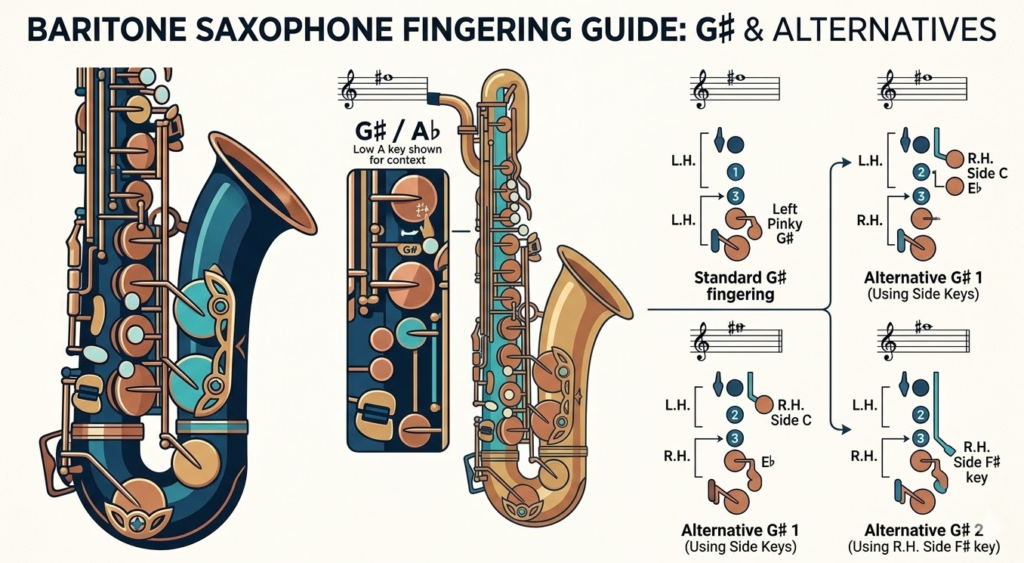
When discussing the alternative fingering g sharp baritone sax, it is important to understand how the standard fingering functions first. The normal G♯ fingering typically involves pressing the G♯ key with the left-hand little finger while other keys remain open depending on the surrounding notes.
While this fingering works reliably, it can become awkward during fast passages, particularly when transitioning between notes that also use the left-hand pinky keys. Because of these mechanical limitations, players frequently explore alternative solutions.
These solutions help performers achieve smoother transitions, better intonation, and more comfortable hand movement.
Why Musicians Use Alternative Fingerings
Alternative fingerings are a fundamental part of advanced saxophone technique. They allow musicians to adapt the instrument’s mechanical system to different musical contexts.
The alternative fingering g sharp baritone sax becomes especially valuable in passages where the standard fingering causes technical obstacles. In fast jazz improvisations, for example, the left-hand pinky may already be engaged with other keys, making the traditional G♯ fingering difficult to execute smoothly.
Alternative fingerings can also influence tone color and tuning. On large instruments like the baritone saxophone, slight changes in fingering can alter the acoustic balance of the instrument. Skilled players sometimes choose an alternative fingering to stabilize pitch or improve resonance.
Another reason musicians learn the alternative fingering g sharp baritone sax is ergonomic efficiency. The baritone saxophone requires larger hand movements than alto or tenor saxophones, so minimizing unnecessary motion can significantly improve speed and endurance during long performances.
The Standard G Sharp Fingering on Baritone Sax
Before exploring alternatives, it is important to understand the standard method.
The normal G♯ fingering on baritone saxophone is typically played by pressing the dedicated G♯ key with the left-hand little finger. This key closes a specific tone hole that adjusts the pitch to G♯.
In many musical contexts, this fingering works perfectly. It provides stable intonation and a consistent tone. However, problems arise when the player must quickly alternate between G♯ and notes like B, C♯, or low C♯, which also require the left-hand pinky.
In such situations, the alternative fingering g sharp baritone sax approach becomes highly useful.
Musicians often learn these variations gradually as they encounter technically challenging passages in repertoire.
Also Read:9.7.4 Leash CodeHS Answers Complete Guide to Understanding and Solving the Exercise
Common Alternative Fingering G Sharp Baritone Sax Techniques
Several practical techniques exist for producing G♯ without relying solely on the standard pinky key. Each version of the alternative fingering g sharp baritone sax has its own advantages depending on the musical situation.
One common approach involves using side keys in combination with other tone holes to approximate the pitch of G♯. This method is often used during fast chromatic runs where the left-hand pinky needs to remain free.
Another approach uses a partial fingering adjustment involving neighboring keys that modify the airflow and pitch slightly. Skilled players can manipulate these subtle variations to produce a stable G♯ while keeping their hands in a more comfortable position.
Some saxophonists also experiment with venting techniques that involve leaving certain keys slightly open. While these methods require careful control of embouchure and air support, they can provide a smooth alternative when the standard key mechanism slows down the passage.
Because the baritone saxophone has unique acoustical characteristics, the alternative fingering g sharp baritone sax may sound slightly different from instrument to instrument. Professional players learn to adjust their embouchure and air pressure to compensate for these variations.
When to Use Alternative Fingering G Sharp Baritone Sax
Not every musical situation requires alternative fingerings. Understanding when to apply the alternative fingering g sharp baritone sax is a key part of developing advanced technique.
Fast technical passages are one of the most common scenarios. In jazz solos or contemporary classical music, rapid note sequences may demand finger movements that are physically difficult using the standard G♯ key.
Alternative fingerings also become useful when transitioning between notes that share the same pinky keys. For example, moving quickly between G♯ and low C♯ can feel awkward if both require the same finger.
Another situation involves intonation adjustments. Certain baritone saxophones may produce a slightly sharp or flat G♯ depending on the mouthpiece, reed, and player’s embouchure. Some alternative fingerings help stabilize the pitch in these cases.
Additionally, composers sometimes write passages that require sustained technical agility. In these moments, experienced performers rely on the alternative fingering g sharp baritone sax to maintain smooth phrasing without unnecessary hand movement.
Tone and Intonation Considerations
Every fingering choice on a saxophone affects tone production and pitch accuracy. The alternative fingering g sharp baritone sax is no exception.
Because baritone saxophones produce sound through a long air column, small changes in key combinations can influence resonance and tuning. Some alternative fingerings may slightly brighten or darken the tone.
Professional players carefully test different fingerings to determine which option produces the most consistent sound in a given musical context.
Also Read:Classroom 30x Redefining the Future of Smart Learning Environments
Intonation is another important factor. Certain alternative fingerings may require subtle embouchure adjustments to keep the pitch centered. Developing a strong ear and practicing with a tuner helps players refine these adjustments.
Ultimately, mastering the alternative fingering g sharp baritone sax requires balancing mechanical convenience with tonal quality.
Practicing Alternative Fingering G Sharp Baritone Sax
Learning alternative fingerings is most effective when integrated into daily practice routines. Rather than memorizing fingerings in isolation, musicians should apply them within scales, arpeggios, and musical passages.
Practicing chromatic scales is an excellent way to explore the alternative fingering g sharp baritone sax. By repeating the note in different contexts, players can identify when the alternative fingering feels more natural.
Long tone exercises also help develop control and consistency. Sustaining the alternative fingering for G♯ allows musicians to evaluate tone stability and adjust their embouchure if necessary.
Another effective approach involves practicing musical excerpts that contain frequent G♯ transitions. Gradually increasing the tempo helps players build muscle memory and confidence with the alternative technique.
With consistent practice, the alternative fingering g sharp baritone sax becomes an automatic part of a player’s technical vocabulary.
Role in Jazz and Improvisation
Jazz musicians often rely heavily on alternative fingerings because improvisation demands flexibility and speed. Rapid melodic ideas may include unusual note combinations that are difficult using standard fingerings.
In these situations, the alternative fingering g sharp baritone sax provides a practical solution for maintaining fluid phrasing. Jazz performers frequently adapt fingerings in real time to match the direction of their improvisation.
Baritone saxophonists in big bands also encounter challenging passages that require technical agility. Alternative fingerings help them execute fast ensemble lines without sacrificing tone or rhythmic precision.
Also Read:How to Get Pink Petal Kosode Armor Naoe
Because jazz emphasizes personal style, players often develop their own variations of the alternative fingering g sharp baritone sax based on their instrument setup and playing preferences.
Equipment Factors That Influence Fingering Choices
The effectiveness of any alternative fingering depends partly on the instrument and equipment being used.
Different baritone saxophone models may respond differently to the alternative fingering g sharp baritone sax due to variations in tone hole placement and key design. Vintage instruments, for example, sometimes have slightly different acoustical behavior compared to modern designs.
Mouthpieces and reeds also influence the stability of alternative fingerings. A mouthpiece with a larger chamber might produce a fuller tone but require more precise embouchure control when using alternative fingerings.
Reed strength can also affect response. A reed that is too soft may cause instability, while a slightly stronger reed can help maintain consistent pitch when experimenting with the alternative fingering g sharp baritone sax.
Players often test multiple equipment combinations to determine which setup supports their preferred fingering techniques.
Building Muscle Memory and Technical Confidence
One of the most important aspects of mastering the alternative fingering g sharp baritone sax is developing muscle memory. Repetition and mindful practice help the fingers learn efficient movement patterns.
Instead of thinking consciously about the fingering every time, experienced players eventually internalize the motion. This allows them to focus on musical expression rather than technical mechanics.
Slow practice is particularly effective when learning new fingerings. Gradually increasing tempo ensures accuracy while reinforcing coordination between the hands.
Over time, the alternative fingering g sharp baritone sax becomes a natural extension of the performer’s technique, enabling smoother phrasing and greater artistic freedom.
Historical Development of Saxophone Fingering Systems
The saxophone was invented in the nineteenth century by Adolphe Sax. From the beginning, the instrument was designed with a flexible fingering system that allowed multiple key combinations for certain notes.
As saxophone performance evolved in classical and jazz traditions, musicians began experimenting with alternative fingerings to address technical challenges. Over decades of experimentation, these techniques became part of advanced pedagogy.
The alternative fingering g sharp baritone sax is one example of how players adapt the instrument’s mechanical design to meet modern musical demands.
Today, saxophone teachers often introduce alternative fingerings during intermediate or advanced training to help students navigate complex repertoire.
Conclusion
Learning the alternative fingering g sharp baritone sax is an important step for saxophonists who want to refine their technical control and musical flexibility. While the standard G♯ fingering works well in many situations, alternative approaches provide valuable solutions for fast passages, difficult transitions, and subtle intonation adjustments.
Because the baritone saxophone has unique physical and acoustic characteristics, mastering these techniques requires experimentation, careful listening, and consistent practice. By integrating alternative fingerings into scales, exercises, and repertoire, players can develop smoother phrasing and greater confidence across the instrument’s range.
Ultimately, the alternative fingering g sharp baritone sax represents more than just a technical shortcut. It reflects the creativity and adaptability that define skilled saxophone performance. Musicians who understand and apply these techniques gain greater freedom to focus on musical expression while navigating the instrument’s mechanical complexity.
FAQs
What is the purpose of the alternative fingering G sharp baritone sax technique?
The alternative fingering g sharp baritone sax technique helps players navigate difficult passages more smoothly by reducing awkward finger movements and improving technical efficiency.
Does the alternative fingering G sharp baritone sax affect tone quality?
Yes, some versions of the alternative fingering g sharp baritone sax can slightly change tone color or pitch. Skilled players adjust their embouchure and air support to maintain consistent sound.
Should beginners learn alternative fingering G sharp baritone sax?
Beginners usually start with standard fingerings first. However, intermediate and advanced players benefit greatly from learning the alternative fingering g sharp baritone sax as their repertoire becomes more technically demanding.
How can I practice the alternative fingering G sharp baritone sax effectively?
Practicing scales, long tones, and musical passages that include G♯ helps integrate the alternative fingering g sharp baritone sax naturally into daily playing. Slow practice and gradual tempo increases are especially helpful.
For more updates visit: blogify News